
Phylum Echinodermata
MORPHOLOGY
Images modified from figure in Spencer and Wright, 1966
Images below compare the morphology between recent asterozoans.


TERMINOLOGY
Definitions of terms taken from Spencer and Wright, 1966
Adambulacral Ossicle of series on oral surface of ray, next to ambulacrals.
Ambulacral Ossicle of axial skeleton, one of double series of opposite or alternate ossicles formed along radial water vessel that constitutes axis of ray or arm; also pertaining to series of ambulacral ossicles.
Ambulacral groove Axial depression along oral surface of ray that is roofed by series of ambulacral ossicles.
Ampulla (pl., ampullae) Dorsal saclike part of tube foot, either seated externally in cupule or internally and connecting with podium (external extension of tube foot) through podial opening; ampullae may be single or double.
Arm Radial extension of the body surrounding axis consisting of ambulacra (ossicle of axial skeleton); arms may be distinct from disk or not.
Axillary In axil (an angle formed by junction of rays or arms with straight sides); generally applied to single large ossicle in axils of certain asteroids.
Carinal Ossicle of a series along mid-line of aboral surface of ray, in line with primary radial if present.
Disk Central part of body, more or less distinctly separable from arms.
Dorsolateral Ossicle of series on aboral surface of ray, between carinals and marginals (syn., adradial); also directed toward axis of ray.
Granulate Covered with granules. Granules are minute, more or less spherical skeletal elements situated on the surface of ossicles, generally in pits or distributed in covering skin.
Inferomarginal Ossicle of a series along the oral edge of arms or disk or both; in origin part of the adaxial skeleton.
Interbrachial Between the arms; applied to margin or surface of disk or to internal structures.
Interradial Indicating position midway between axis of adjacent rays or area between such rays.
Madreporite Spongy or sievelike ossicle that serves as inlet to the water vascular system; it is located interradially, lateral in some primitive asterozoans, but on the aboral surface in most asteroids and a few ophiuroids and on the oral surface in other phiuroids.
Marginal Ossicle of a series along the edge of the body.
Ossicle Any individual calcified element of skeleton, but normally used for larger of such elements.
Papula (pl., papulae) Short protuberance of integment between ossicles of aboral or oral surface of asteroids that functions as external gill.
Papular opening Gap between ossicles for protrusion of papula.
Paxilla (pl., paxillae) Ossicle of extraxial skeleton with shaft surmounted by tuft of spinelets.
Peristomal ring Plates surrounding the opening for mouth.
Podial opening Passage between ambulacrals for passage of tube foot.
Radial Prominent ossicle on aboral surface of asteroids, in line with mid-line of arm, forming part of primary circlet; commonly used in older literature for any ossicle in series with primary radial (see carinal); also applied to organs extending along arms.
Ray Segment of the body that includes one ambulacral axis.
Spine Sharp or blunt, short or long skeletal element, attached to ossicle by muscle.
Superomarginal Ossicle of series along edge of disk or arms or both, above series of inferomarginals.
MORPHOLOGY
Image from Ubaghs, 1978
Basic crinoid morphology is labeled on the sketch below.


TERMINOLOGY
Definitions of terms taken from Moore et al., 1978
A ray Anterior ray located opposite the posterior interray designated CD, generally wider than others and containing anus or anal plates; includes radial and succeeding brachitaxes with intervening plates as well as pinnules. Other rays designated B, C, D, and E in clockwise order from A, viewing adoral side of theca.
Aboral cup Part of aboral side of body between origins of free arms and column.
Anal sac Variously shaped, generally inflated and strongly elevated part of tegmen as developed among inadunate crinoids.
Anal tube Conical to cylindrical structure, usually of considerable height, bearing anal opening at its summit, typically developed in many camerate, flexible, and articulate crinoids.
Arm Radial evagination of body above radial, normally extending upward or outward from theca, containing coelomic canals, and composed of pinnulate or nonpinnulate brachitaxes. Restricted by some authors to undivided distal branches.
Axial canal Longitudinal passageway for axial cord penetrating columnals, cirrals, thecal plates, arms, and pinnules, generally but not invariably located centrally; may be simple or multiple with main canal accompanied by smaller accessory ones.
Axillary Brachials (any plate above the radials or biradials) that support two arm branches.
Axil-arm Arm including its branches borne by any branch of main-axil as seen in calceocrinids but excluding terminal branchlet termed omega-ramule.
Basal Any plate of circlet next proximal to radials, each basal typically in interradial position.
Bilateral heterotomy Type of arm branching characterized by occurrence of ramuli on either side of main arm.
Brachitaxis Series of brachials (any plate above the radials or biradials) extending from radial or biradial to and including primaxil or in arms lacking axillaries to distal extremity of arm; likewise brach series extending from any axiallary to and including next one or to distal extremity of arm or branch.
Column Series of segments composing stem; excludes holdfasts.
Columnals Individual ossicle (calcified segment of skeleton) of crinoid stem.
Crown Whole crinoid exclusive of stem.
Cup See aboral cup.
D ray See A ray.
E ray See A ray.
Food grooves Simple or branched furrow running in adoral surface of tegmen, arms, and pinnules; serves to convey food to the mouth.
Heterotomous branching Arm characterized by division into unequal branches.
Holdfast Any structure at distal extremity of column serving for fixation.
Infrabasals Any plate of proximal circlet in aboral cup having two circlets of plates below radials.
Isotomous branching Characterized by division of arm in equal branches.
Nodose Having a nodular appearance.
Non-pinnulate Without pinnules.
Pinnulate Having pinnules.
Pinnules Generally slender, unbifurcated, uniserial branchlet of arm, typically borne on alternate sides of successive brachials (any plate above the radials or biradials) except hypozygals and axillaries.
Plate Tabular ossicle (calcified segment of skeleton), mostly having articular facets at edges.
Primiaxillary Axillary plate of proximal brachitaxis.
Primibrachs Plates of proximal brachitaxis; may axillary or non-axillary and fixed or free.
Quartibrachs Any ray plates of fourth brachitaxis.
Radial Undivided proximal plate or any ray, may be simple or compound and bearing proximal anal plate.
Ramule Bifurcating or nonbifurcating minor branch of arms, differing from pinnule in less regular occurrence and in some crinoids by presence of pinnules on it.
Ray Radial plate, together with all the structures borne by it.
Secundibrachs Any ray plates of second brachitaxis.
Stem Stalklike attachment of many crinoids; column.
Tegmen Adoral part of theca above origin of free arms or occupying space between them; may be calcified or not; may bear anal vent, pyramid, sac, or tube.
Tertibrachs Any ray plates of third brachitaxis.
Theca Crinoid skeleton exclusive of pelma (column and holdfast) and free arms.
MORPHOLOGY
Image modified from Regnell, 1966
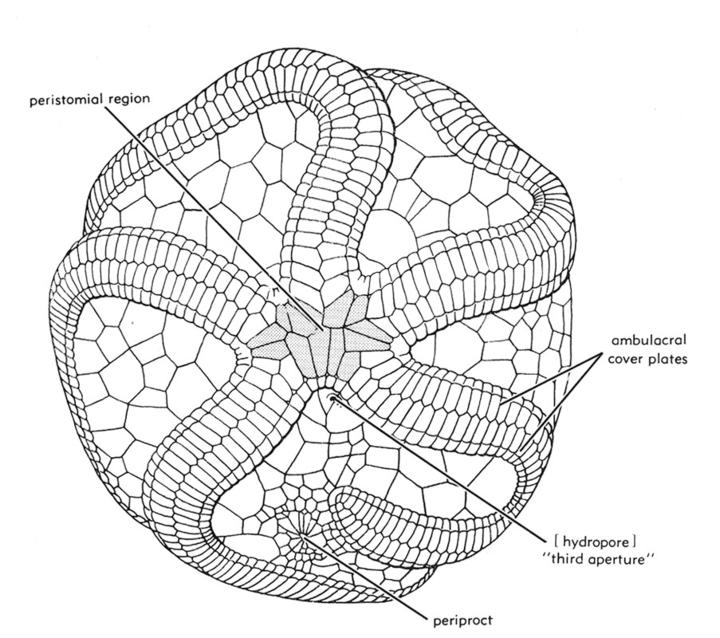
The following image is provided to simply give an idea of basic external characteristics of Edrioasteriods.

MORPHOLOGY
Images from Sprinkle and Kier, 1987
The images below illustrate the external characteristics of Stylophora (left thumbnail) and Homoiostele (right thumbnail) Homalozoans.


TERMINOLOGY
Definitions of terms taken from Ubaghs, 1967
Stylophora
Placocystitid plate Special supracentral located on mid-line of theca and generally surrounded by its two neighbors, distinguished by its smooth surface and its rounded (rather than polygonal) outline.
Carapace Upper face of theca.
Aulacophores Single jointed exothecal appendage, here interpreted as brachial process carrying ambulacrum (structure in which food is conveyed to the mouth).
Theca Body skeleton exclusive of aulacophore.
Homoiostelea
Stele Relatively slender and tapering peduncular prolongation of the body.
Theca Body skeleton exclusive of stele.