
Depositional Environments
Introduction to the Depositional Environments of the Trenton Group
Given the long period of geologic research on the Trenton Limestones, it is no surprise that extensive studies have been made of the the stratigraphy and sedimentology of these fossiliferous limestones. Nearly 150 years were dedicated to the study of the stratigraphy and paleontologic compositions of the Trenton, and only within the last half century have researchers begun to interpret the depositional histories of these heterolithic limestones using paleontologic and sedimentologic clues.
The graduate studies of Chenoweth (1952) began a long tradition of paleoecologic and paleoenvironmental studies on the Trenton, through the work of Dr. Marshall Kay and his students. Subsequent publications by Cameron (1968), Mangion (1972), Titus (1974), Cameron and Mangion (1977), Titus and Cameron (1976), and Cisne and Rabe (1978), helped to establish the relative framework of depositional environments under which the Trenton Limestones were deposited. Although more recent observations have modified some of the initial assessments, these pioneering studies helped to refine the stratigraphic history of the Trenton and its role in the development of the Taconic Orogeny.
The following discussion focuses on some of the specific sedimentologic and paleontologic details related to the assessment of depositional environments for the Trenton. In some cases, generalized interpretive diagrams have been used to clarify specific points for the reader. As in all cases, the purpose of this discussion is only to provide the reader with information substantive to the interpretation of the Trenton Limestones.
As presented in the geologic background discussions of "Tectonic Setting" and "Paleogeographic Setting," the development of the Trenton Shelf and hence the deposition of the Trenton Limestones was tied to the modification of depositional environments on the margin of ancestral North America during the Upper Ordovician Taconic Orogeny. Over a period of four to five million years, the cratonic margin of Laurentia was modified from a sub-tropical shallow peritidal carbonate platform into a distally steepened foreland basin. The long term change in shelf morphology and topographic expression, along with global sea-level fluctutations, substantially impacted the deposition of carbonate rocks on the Trenton Shelf.
The following diagram modified from Brookfield and Brett (1988) shows a schematic cross-section of the Trenton Shelf (bottom) to Taconic Foreland Basin. In this figure, the authors establish the comparison between the Ordovician of eastern Laurentia and the modern cross-section from northern Australia to the accretionary prism/volcanic arc terrains of Timor (top). Although the pattern of deposition across the Trenton Shelf has been well studied, the intent of the comparison here was to demonstrate the relative transition from coarse-grained, shallow water carbonates to deep shelf interbedded (parallel-layered) fine-grained carbonates and shales, and thence into siliciclastic dominated shales and sandstones in the Timor region. Very similar patterns of deposition have been established within the Taconic Foreland Basin, although the Trenton Shelf did not exhibit the same development of hermatypic reefs as shown in northern Australia.

As shown schematically above, the Trenton Shelf to proximal foredeep basin areas, although influenced by local tectonic events through time, were dominated by carbonate production and deposition in a range of relatively shallow to relatively deep-water conditions, both in somewhat protected and open water environments on the shelf. As a consequence of these variations in depositional settings, the relative compositions of the Trenton Limestones are quite variable as well. Despite this variability, all Trenton Limestones contain appreciable quantities of dark grey siliciclastic shales and silty mudstones derived from the Taconic terrains to the east.

The deposition of carbonates on the Trenton Shelf was undoubtedly poised between carbonate production, the transport of carbonate sediments from more proximal (shallower) shelf areas and siliciclastic influx from distal orogenic sources. The following diagram, although representing depositional conditions and sediment transport processes immediately following the deposition of the Trenton, helps to illustrate this later point. In the diagram, redrawn from Lehmann and others 1994, the Trenton Shelf is shown to the left, with sediment transport directions indicated by the arrows. Clearly the deposition of materials in the Taconic Foredeep Basin, as well as along the margins of the basin, are related to downslope transport of sediments from both directions. In the case of the Trenton Limestone (the top of which is colored white in the image above), sediment transport directions were similar except that the supply of siliciclastic sediments was much lower, as the source terrain was further away. Shallower water depths favored more oxygenated depositional conditions under which carbonate production could occur.
As presented in the section on Lithology, the Trenton Limestones range in character from thin-interbedded shales and fine-to-cryptocrystalline grained limestones to more massive cross-bedded coarse grained carbonates. Obviously, the deposition of these heterolithic carbonate rocks resulted from a variety of processes impacting a range of depositional settings.
In order to demonstrate the depositional conditions under which the range of Trenton lithololgies were deposited, the image below modified from Tucker and Wright (1990) is shown. It helps to relate water depth and energy conditions relative to depositional environments and rock types on a gently-dipping carbonate ramp similar to the Trenton Shelf. The diagram is arranged with shallowest water environments to the right in "back ramp" areas through deep "basin" environments to the left. In between are intermediate areas referred to as "shallow ramp" and "deep ramp," with the boundary between established roughly at the lower limit of fair weather wave base (fwwb).
CARBONATE RAMP DEPOSITIONAL MODEL

Protected/subaerial carbonate depositional environments: Back ramp
Environmental parameters of the back ramp
In the carbonate ramp depositional model shown above, back ramp areas are delineated as being landward of high energy depositional environments of the shallow ramp. Because wave energy is usually dissipated in shallow ramp areas, back ramp regions, otherwise typified by lagoons, tidal flats, saline ponds, and subaerially exposed carbonate flats, are broadly characterized by very shallow (<5m), quiet water conditions. These regions tend to experience wide salinity fluctuations and can range from very saline to brackish water conditions depending on freshwater runoff and evaporation rates. These environments, especially in the Ordovician, tend to be dominated by a low diversity fauna (especially in the shallowest areas of the lagoons and tidal flats) tolerant of these stressed conditions.
Lithofacies associations of the back ramp
Within this context, carbonate rocks range from thinly laminated, vertically-burrowed micritic limestones through massively-bedded bioturbated, coral-rich wackestones. In the more seaward regions of the back ramp, bioturbated wackestones may transition to slightly more fossiliferous packstones to grainstones due to the increased influence of high-energy environments of the shallow ramp. Because of the potential for hypersalinity, evaporites and dolomitic carbonates can also be deposited. In rarer instances, channels and beach areas can develop if tides or wave energy penetrates the back ramp area. Some skeletal grainstones can develop in these settings, but tend to be localized around islands or other topographic highs. >>Back to Top
Wave dominated: Shallow ramp
Environmental parameters of the shallow ramp
In the figure by Tucker and Wright (1990), the region immediately outboard of the back ramp is referred to as the wave-dominated shallow ramp. This depositional setting is characterized by a range of sub-environments including: beaches, barrier bars, strand plains, shoals, and may also include a variety of reef formations. The primary environmental control on this depositional setting is the predominance of high-energy wave oscillations which agitate the waters on a regular basis.
Given this environmental parameter, shallow open ramp environments range from sea-level to the base of the fair weather wave base, which in most cases is generally between 5-15 meters water depth. These depositional settings, although turbulent, are well above the photic zone and are generally characterized by a high diversity of shelly faunas and calcareous green algae, both of which produce large volumes of carbonate sediments.
Lithofacies associations of the shallow ramp
The daily wave agitation in these open water depositional conditions helps to disarticulate, fragment, abrade, sort, and winnow carbonate sediments. These processes remove fine-grained sediments and leave behind only the coarsest shell fragments and carbonate grains. These depositional environments are typically carbonate mud-poor and tend to be rather thickly bedded, and may exhibit cross-bedded packstones to grainstones lithofacies. In the Ordovician, these rock types are typically dominated by crinoid or other echinoderm, brachiopod, and bryozoan debris. >>Back to Top
Proximal deep ramp: Below fair weather wave base
Environmental parameters of the proximal deep ramp
In the model of Tucker and Wright (1990), the region on the ramp from normal wave base down to storm wave base depths is classified as the deep ramp depositional environment. In this setting, deposition is dominated by relatively low energy depositional processes which are interrupted intermittently by high-energy events commonly associated with storms, increased storm wave winnowing, and downslope transport of sediments derived from upslope areas. The depth here in most modern seas ranges between 15 m to 50 m. In some cases, as in the case of the largest storms, storm wave base can extend much deeper depending on the trajectory of the storm and the morphology of the shelf/ramp on which it impinges.
Within this relatively wide-range of water depths, proximal deep ramp areas generally reside within the limits of the photic zone and are amicable to the growth of diverse macrofaunal benthic assemblages. Depending upon the frequency of storm events and the turbidity of the water column, the faunas in these settings can be influenced by a variety of environmental parameters including light intensity variations, sedimentation rate, dissolved oxygen concentration, salinity, and temperature variations.
Lithofacies associations of the proximal deep ramp
In an extremely simplified description, Tucker and Wright's (1990) figure indicates that deep ramp depositional environments are characterized by the deposition of thin-bedded limestones including storm deposits, mud mounds and interbedded shales. The accumulation of thin-bedded limestones result both from in situ accumulation of skeletal fragments, and storm-transported carbonate deposition. The accumulation of mud mounds and thin shale interbeds result from background sediment accumulation during low energy conditions via a variety of settling processes including suspension settling, flocculation and pelletization. These environments are usually characterized by barren micrites, skeletal wackestones, and rarely skeletal packstones to fine-grainstone facies. >>Back to Top
Distal deep ramp: Well below storm wave base
Environmental parameters of the distal deep ramp
The lower regions of the ramp are typified by facies intermediate between those found in the more proximal portions of the ramp and fully basinal deposits. Thus defined, the distal deep ramp would range from areas not impacted significantly by normal storm wave base, and only occasionally impacted by the largest of storms, as well as gravity, density, and turbidite flows.
Lithofacies associations of the distal deep ramp
The distal deep ramp areas areprimarily below the photic zone; they are impacted by the deposition of distal turbidites, pelagic carbonates, and shale interbeds. As the environmental parameters are stressed, the majority of carbonates are supplied from upper waters, but as the region is intermittently receiving carbonates from the ramp it is considered a separate facies from the basin. The lithofacies of the distal deep ramp tend to be dominated by fine-grained pelletal micrites (pelagic), thinly laminated calcilutites and calcisiltites (turbiditic), and interbedded shales (oscillation in background sedimentation). Occasionally distal debris flows or very distal tempestite wackestones are deposited. Faunal signatures of this facies are relatively few due to the low light intensities and variable oxygen content of bottom waters. With only minor diminutive shelly faunas, deep water trilobites, and minor to moderate bioturbation, this depositional setting is indeed differentiated from the proximal shelf regions.
Basin
Environmental rarameters of the basin
The term "basin" is used in reference to the deepest part of the depositional basin, which for the purpose of the discussion here is represented by the Taconic Foredeep Basin. In this model it refers to the depositional setting that is usually well beyond the limit of extreme storm wave base and turbidite deposition. As these very deep environments are usually greater than 200 m, environmental conditions are well below the limit of the photic zone and beyond the limits of near-surface energy distribution processes. However in some basinal settings, density-driven bottom currents can and sometimes do impact the accumulation of some depositional materials. Within the context of the Taconic Foredeep Basin, there is some evidence for the alignment of graptolite theca in response to the flow direction of these bottom currents.
Aside from minor density-driven currents, basinal depositional settings are generally influenced primarily by the supply of oxygen. Referring to the figure shown above by Lehmann and others (1994), these regions can range from fairly well oxygenated settings through oxygen-stressed to oxygen-minimal zones. The presence or absence of oxygen influences greatly both the biotic composition and the depositional signature of the basinal setting.
Lithofacies associations of the basin
As indicated in the diagram above by Tucker and Wright (1990), the most distal portion of the carbonate ramp model contains at least some pelagic carbonate interbedded with shales. In these depositional settings the predominant materials deposited are fine clay and silts that rain down from the upper water column. Provided a carbonate source is nearby or the production of calcium carbonate occurs via plankton blooms in near-surface waters, these environments are also capable of accumulating fine-grained pelagic carbonate oozes if bottom-water chemistries are oxygenated and not too corrosive. Most basinal settings are characterized by alternating pelagic cryptocrystalline carbonates and shales. In the absence of low oxygen conditions and fairly corrosive bottom waters, deep basinal settings often become characterized by black shale-dominated deposition with very little carbonate preserved.
No one individual worker has investigated the depositional environments of the entire Trenton Limestone in the Trenton Falls region. However, much work has been done on individual units, especially in the lower and middle Trenton (see Titus, 1974; Titus and Cameron, 1976, Cameron and Mangion, 1977; Mehrtens 1988, Mehrtens, 1992), and more recently in the mid-to-upper Trenton (Mitchell et al.1993; and Brett and Baird, 2002). In coeval Trenton strata in southern Ontario , Brookfield and Brett (1988) investigated the sedimentologic and stratigraphic signatures of the Trenton Limestones and diagnosed the paleoenvironmental conditions under which the Trenton Limestone formed in Ontario and adjacent areas in New York State .
Brookfield and Brett delineated 9 different depositional facies or lithotypes in the Trenton of Ontario. Based on comparisons between the studies of the Trenton Falls to northern New York region, the studies of Brookfield and Brett show nearly the same facies types. The shoal-to-basin lithofacies associations that Brookfield and Brett delineated are shown in the modified figure below to accentuate the relationship between sedimentary facies, and depositional environments. The interpretation of depositional environments depends on a variety of sedimentologic indicators including grain types and textures, bedding style and sedimentary structures, siliciclastic composition, as well as biofacies. Thus, the figure is designed to relate sedimentologic characteristics, depositional setting, and environmental energy as a function of sea-level. Notice that facies are color coded and numbered from deepestwater facies through shallowest water facies, and although the lithofacies number generally increases with decreasing water depth and increasing energy, it is not always the case.

Back ramp in the Trenton?
While the pre-Trenton, Black River Group rocks of Turinian Age are almost entirely represented by rocks deposited in these depositional environments, the majority of the Trenton Limestones from central New York State are now considered to have been deposited in more offshore conditions. Further details of this depositional setting herein are minor, and if present at all are locally developed around small topographic highs, i.e. the Middleville Arch.
Shallow ramp in the Trenton?
There are several lithologic units in the Trenton Limestone succession that fall within the classification of the shallow wave-dominated ramp.
Watertown limestone-to-Selby Formation: Beginning just below the basal Trenton in the northern New York to southeastern Ontario region, the Watertown to basal Selby formations sharply overly the peritidal back ramp facies of the Black River Group. Beginning in the Watertown, but continuing into the Selby, massively bedded wackestones, packstones and fine-to-medium bedded ruditic grainstones exhibit many sedimentary characteristics typical of shallow ramp conditions (Young, 1943; Cameron & Mangion, 1977; Cornell, 2001). The predominance of corals, crinoids, brachiopods, bryozoans, stromatoporoids as well as many types of green algae including Receptaculites indicate dominantly shallow water conditions, while coarse grain sizes indicate that these rock units were commonly influenced by wave winnowing processes. These rock units also contain oolitic grains and often show cross-bedding especially in Ontario. In the Trenton Falls region, the Watertown to Selby intervals thin substantially from shoaling conditions in the Black River Valley (Cameron & Mangion, 1977), and show the transition to back ramp depositional features. Using the lithotype classification system of Brookfield and Brett (1988), as shown above, these units would most likely range from lithotype numbers 4, 5, 6, and 7.
Lower Kings Falls Formation: Like the Watertown-to-basal Trenton Selby Formations, the basal Kings Falls Formation exhibits aspects of shallow wave-dominated deposition. In the case of the Kings Falls, although medium-bedded and interbedded with thin dark shales, the development of coarse-to-medium grained grainstones, coquinal calcarentites, and high-energy depositional structures including ripple marks, intraclasts, cross-bedding, and erosional surfaces suggest offshore shoal deposition (Mangion, 1972; Titus, 1974). Some minor lateral facies change does occur within the basal Kings Falls; however, the dominance of this rather homogeneous unit across New York and into Ontario suggest fairly uniform shallow water depths across the entire shelf. Using the lithotype classification system, the lower Kings Falls probably represents numbers 5, 6, 7, and 8.
Upper Sugar River Formation: Rathbun Member: The next unit in the Trenton to display evidence of shallow ramp depositional conditions is the upper Rathbun Member of the Sugar River Formation. Although this unit has been traced across central to northern New York State, the Rathbun Member displays a multiplicity of lithofacies grading from fine-grained limestones in the north into a thin interval of coarse-grained crinoidal packstones and grainstones in the area of Middleville, New York (southeast of Trenton Falls). Only in the region of Middleville is the Rathbun considered to have been deposited in shallow ramp shoaling environments where deposition was influenced by higher energy conditions on a topographic high. The localized, as opposed to the widespread as in the Kings Falls, development of the coarsest Rathbun facies is related to the tectonic modification of the Trenton Shelf during this time. The shallow Middleville Rathbun deposits represent the last occurrence of shallow ramp depositional facies in the lower to middle Trenton interval.
Steuben Formation: After the deposition of the Rathbun Member, there is very little sedimentary evidence from the middle Trenton Limestones for shallow ramp deposition. The entire succession from the Denley Formation to the Rust Formation is nearly devoid of such shallow water signatures. In fact, not until the very top of the Trenton did water depths again shallow enough for coarse-grained carbonate deposition to occur. As the capping unit of the Trenton Limestone, the Steuben Formation reprepresents the final phase of shallowing and carbonate dominated deposition on the Trenton Shelf prior to the migration of the Taconic Foreland Basin into central New York State. In the Trenton Falls gorge, as in many localities in the West Canada Creek region, nearly the entire Steuben Formation is composed of rather thick- to massive-bedded, cross-stratified crinoid brachiopod grainstones. This unit is very massive in the Trenton Falls region and a dominant feature of the Upper Trenton Falls Gorge. The coarse-grained facies is found from this area northward into northern New York, where the thickness and intensity of grainstone dominance subsides. However, in the easterly direction, the Steuben rapidly grades into deeper ramp to basinal facies of the Dolgeville and Indian Castle formations. Using the scheme of Brookfield and Brett (1988), the Steuben facies would be classified as lithotypes 6, 7, and 8.
Proximal deep ramp in the Trenton?
Despite the relatively simplified schematics discussed above, the range of rock types and potential depositional processes impacting the accumulation of sediments on the proximal deep ramp are wide ranging and somewhat complex. Within the Trenton, the majority of formations from base to summit show evidence of the alternation between storm influenced and background deposition. Previous researchers including Cisne and Rabe (1978), Cisne and others (1982) and Mehrtens (1984; 1988) have worked to document the depositional processes and environments under which, and within which these limestones were deposited. The proximal deep ramp is perhaps one of the most dominant depositional settings represented in the Trenton Group, with the majority of the middle Trenton Limestones including the Upper Kings Falls Formation, the Denley Formation, and the Rust Formation, revealing this depositional environment.
Upper Kings Falls Formations: The Upper Kings Falls Formation and the overlying Sugar River Formation are ubiquitous deeper water components of the Trenton Limestones. Although the Upper Kings Falls represents slightly shallower conditions than the Sugar River Formation, the depositional facies of this unit is still substantially less energetic than that of the Lower Kings Falls with significantly less coquinas, calcarenites and rippled, cross-stratified grainstones (Titus, 1974). The overlying Sugar River Formation contains still fewer coarse grained limestones, is dominated by thin-bedded shaly nodular, fine-grained carbonates and most likely represents an even deeper water setting. In addition to sedimentologic indicators, Titus (1974, 1976) has shown that the communities of the Upper Kings Falls " Liospira Assemblage" show intermediate water depth affinities between the subjacent lower Kings Falls "Triplesia Assemblage," and the overlying "Encrinurus Assemblage". It is likely that the Upper Kings Falls Formation was deposited in deeper water conditions below fair weather wave base and yet above normal storm wave base. Using the lithotype scheme, the Upper Kings Falls would range between lithotypes 3, 4, 5, and 6.
Denley Formation: Lying disconformably over the top of the Rathbun Member of the Sugar River (shallow ramp facies), the Denley Formation in the region from Trenton Falls southward also falls into the category of proximal to slightly distal ramp. Both members of the Denley Formation, although quite heterolithic from bottom to top, demonstrate a range of lithologic and paleontologic parameters that support this classification. According to Mehrtens (1984), the basal Denley is substantially finer grained (than the underlying Rathbun) with fewer grainstones and more fine-grained calcilutites, and barren unfossiliferous bioturbated micrites; has thicker shale interbeds; and contains individual beds exhibiting graded bedding and sedimentary structures indicative of Bouma type sequences. The Poland member thus ranges between lithotypes 1, 2, 3, and 4.
Compared to the Poland, the overlying Russia Member is substantially more fossiliferous and contains a greater number of skeletal wacke-to packstones. Like the Poland, however, graded beds do occur; in most cases they show a broader differentiation in the type and number of Bouma sequence subhorizons than do those of the underlying Poland. Due to the large numbers of shelly interbeds, the Russia most likely represents a shift to slightly shallower water conditions. The Denley, although variable between more distal to proximal ends of the deep ramp spectrum respectively, exhibits evidence for storm sedimentation and turbidite deposition which are characteristic of the proximal deep ramp succession. Using the Brookfield and Brett scheme, the Russia would range between lithotypes 2, 3, 4, and 5 with occasional beds of lithotype 6.
Rust Formation: Like the underlying Denley Formation, the Rust is represented by multiple internally recognized members. These include the Mill Dam, Spillway, and Prospect Quarry Members (Brett and Baird, 2002). The Rust Formation contains similar lithofacies to the underlying Denley, except that the three members of the Rust Formation exhibit a greater proportion of nodular, wavy-bedded, packstones to fine-grained grainstones (lithotypes 4, 5, and 6) and significantly less quantities of unfossiliferous micrites and calcilutites (1, 2, 3). In addition to these sedimentologic features, the Rust also exhibits two well-developed disturbed horizons informally referred to as the "lower & upper disturbed horizons", which resulted from the lateral downslope movement of unlithified or semi-lithified sediments. In the case of the upper disturbed zone, this horizon in places seems to have infilled previously formed and cut channel features.
Both paleontologic and sedimentologic evidence from the Rust Formation suggests a range of slightly shallower intermediate to proximal deep ramp depositional conditions. The presence of large channel-like features, slump deposits, and fossiliferous wackestones, packstones and fine grainstones suggest deposition in the more proximal portions of the deep ramp.
Distal deep ramp in the Trenton?
Very few limestones of the Trenton Group were deposited within the deeper regions of the ramp. However beginning near the base of the Trenton, the Napanee Formation and the lower to middle Sugar River Formation exhibit aspects of deposition similar to that described for the distal deep ramp settings. Historically, the fine-grained calcisilitites, calcilutites, and interbedded shales of the Napanee Formation have been interpreted to have been lagoonal in origin (Cameron and Mangion, 1976; Titus and Cameron, 1977); however, these limestones do show evidence of distal ramp sedimentation. (Cornell, 2001, Brett and others, 2004). Although the Napanee does show some minor lateral biofacies change, the presence of deeper water faunas including deep water trilobites, diminutive brachiopods, and bryozoans especially in central New York to Northern New York suggest a rather distinctive change from shallower ramp conditions of the underlying Watertown to Selby interval. Using the lithotype scheme of Brookfield and Brett (1988), the Napanee would range from lithotypes 1, 2, 3, with occasional beds of 4 especially in areas closer to tectonically induced topographic highs.
In addition to the Napanee Formation, the lower to middle Sugar River Formation shows similarly developed distal deep ramp litho- and bio-facies. Of all the Trenton Group, the Sugar River, next to the Napanee Formation, is perhaps the most distal of the carbonates on the shelf with the dominant lithotypes ranging between 1, 2, and 3 with occasional lithotypes 4 and 5 possible.
Basinal deposits in the Trenton?
Since nearly the beginning of research on the Upper Ordovician of New York State, the presence of relatively barren, dark brown to black fissile shales of the Utica Group in close association with the fossiliferous limestones of the Trenton Group sparked intense debates about the depositional history and sedimentary relationship of these rocks.
Through the use of modern correlation techniques the specific relationships and timing of deposition of both the Utica Group Shales and the Trenton Limestones is now well constrained. Although there are no truly basinal deposits represented in the Trenton Group, the close association of the Trenton with both the Dolgeville Formation (deepest slope facies) and the adjacent Utica Group shales helps to constrain these later deposits as being the deepest in the Taconic Foreland Basin. The dark organic-rich black shales of the Utica suggest that they were deposited in environments that were very much oxygen-depleted or otherwise euxinic. As the basinal deposits are not the focus of this discussion further information is omitted.
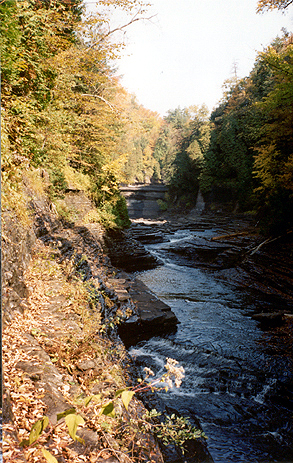
View Upstream from the Narrows toward Sherman Falls, photograph by Tom Whiteley