Golden Era (1843 to 1899)
Seward 's Surveys of New York State highlighted the fantastic fossil assemblages of the Trenton Limestone, and also provided for some interesting debates surrounding the position of the Trenton Limestone relative to other stratigraphic units in the Mohawk and Hudson River Valleys. The work, especially by Lardner Vanuxem (Chief Geologist of the Third Geological District) and Timothy Conrad (State Paleontologist), generated much excitement about the Trenton Limestone. Based on the publication of the annual and final reports of the surveys (1836-1842), great interest was spurred toward further research efforts on cataloging and describing fossil specimens and their stratigraphic position. This included the areal distribution and lateral correlative units of the Trenton. Perhaps the most important change introduced by the Survey was to redirect American geologists toward the development of an American geological column in place of focusing on correlations to British strata.
These initial investigations led to the development of the New York System and with it the great "Taconic Controversy" surrounding the age relationships of lower Paleozoic rocks. These included the Trenton Limestone, the Utica Slate, the Hudson River Group and the Taconic Slates of eastern New York. The greatest combatants involved in the initiation of this argument, James Hall and Ebenezer Emmons, became embroiled in intense debates that ended their working relationship. Despite the conflict between these two individuals surrounding the "Taconic Debate", the contributions made in the initial surveys only spurred the advancement of paleontologic and stratigraphic research in New York State.
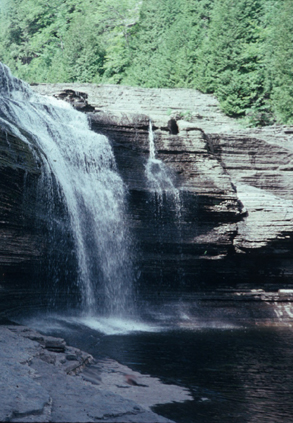
The reports by Conrad and Vanuxem were some of the first widely distributed analyses of the geology of Trenton Falls, but were not the only thing responsible for generating excitement and interest in the geology of the chasm. Despite the death of John Sherman in 1828, the "Rural Retreat" and the falls had already made an impact on the people of the east coast. Soon after his death, Sherman 's son-in-law added on to the "Rural Retreat" and finally opened a new, luxurious hotel and gardens on the site in 1851. Michael and Maria Moore intended to provide a world-class modernized hotel for the entertainment of vacationers and tourists who came to enjoy the Falls. With the establishment of the Utica and Black River Railroad at about the same time, the locality became world famous. In addition to the local tourists that visited the falls, many hundreds of foreign visitors including artists, writers, and politicians made Trenton Falls an important stop on their tours of North America . In fact, Trenton Falls was thought by many of its visitors to be more attractive and grand than the celebrated Niagara Falls. Secretary of State William Seward, because of his connection with the original survey, hosted diplomats from seven nations in 1863 at Moore's Hotel. Even though interest in the geology of Trenton Falls had originated before the hotel, geologists too liked the grander accommodations it afforded.
The analogy from the title of Charlotte Pitcher's book Golden Era of Trenton Falls is used here to indicate approximately the same time period that she referred to in her discussion surrounding the development of Trenton Falls as a grand vacation and tourist destination. The following material, although not directly related to human use of the gorge, provides some commentary on the important people who made significant contributions to the advancement of stratigraphic and paleontologic knowledge of the Trenton Limestone.

Timothy Conrad, first State Paleontologist of the State of New York, was born in Trenton, New Jersey just after the turn of the century. With his childhood romps along the waterways of the region, Conrad soon became fascinated with the shells he collected there. Following his childhood collections and studies, he developed a career working as a conchologist and paleontologist.
Conrad was recommended for a position on the first Geological Survey of New York and after a minor reorganization, Conrad was reassigned the task of cataloging, describing, and curating the immense numbers of rock and fossil specimens collected in the first year of the surveys. Conrad made some of the first assessments and descriptions of fossils found in the Trenton Limestone during the years 1837 to 1842. In his Annual Reports on the Paleontology of the State from 1838 to 1841, his report in the Journal of the Academy of Natural Sciences of Philadelphia (vol. 8, 1842), and his contribution to Emmons' final Report on the Second Geological District, Conrad managed to describe nearly seventy species. Thirty-five of these belonged to the Trenton Limestone (Hall, 1848).
Up to the time of his departure from the Survey, Conrad's achievements far exceeded any other individual's efforts toward the taxonomic description of North American fossils. Moreover, his initial studies made it possible for Hall and others to continue work on the fossils he had curated. After his stint as State Paleontologist, Conrad spent a majority of his later career dedicated to the study of Cenozoic shell assemblages in fresh and marine waters. In this capacity he was a prodigious contributor to the paleontology of the Cenozoic as well as to the malacology of the Recent.

Ebenezer Emmons was born in west-central Massachusetts, and although he studied medicine at Albany and was a practicing physician, his interest in geology had been kindled early in life. Due to his fascination for the region of his birth, he assisted Professor Chester Dewey with the preparation of a geological map of Berkshire County in 1824. This map was the first attempt to classify the rocks of the Taconic area. As a consequence of his success in this endeavor, Emmons accepted an offer to teach natural history and geology at Williams College while simultaneously holding a professorship of chemistry and obstetrics in the Albany Medical College. Like many other geologists of his time, Ebenezer Emmons had training in other fields but found geological study to be a fascinating endeavor. In 1836 he was hired to complete the survey of the Second Geological District for the New York State Survey.

In his final reports on the Second Geological District in 1842, Emmons described the arrangement of his district's strata, and classified components of the local strata into the Taconic and overlying New York systems. Vanuxem had already established the stratigraphic relationship of the Trenton Limestone with respect to other New York System strata and was attempting to establish the connection of these rocks with those found in the Taconic Mountains to the east. Emmons subdivided the New York System into several groups including the Potsdam sandstone (which he defined in 1838), and placed it at the base of the New York system (it is now classified as Upper Cambrian). This assertion was not accepted by many of his colleagues at the New York State Survey and was a point of contention in the completion of the other district reports in 1843.

After losing the State Paleontologist position to Hall, Emmons was appointed State Agriculturist. Despite this position, he continued to be active in geology. In 1844 Emmons obtained fossils from the Taconic system: an exceptional discovery because of the general high-grade metamorphism of the slates, and the fact that the species obtained were unlike any other Paleozoic fossils found in the New York system. Two new species of trilobites obtained in 1844 were thought to be representative of the primordial group, and thus provided Emmons with biostratigraphic evidence that suggested the Taconic slates were at least "Primordial" or early Cambrian in our current nomenclature. It was Emmons' contention, then, that the Taconic System was much older than, and entirely separate from, the New York System of rocks of which the Trenton Limestone was a part. Despite his evidence, heated debates and disagreements with James Hall, William Mather, James Dwight Dana, and Louis Agassiz ensued. They disputed Emmons' claim and felt that the argillites of the Taconics were at least time-equivalent to the New York Series. (Fisher, 1978)

After the conflicts between Hall and other colleagues of the New York State Survey, Emmons left the survey and took a position as head geologist for the Geological Survey of North-Carolina, a position he held until his death in 1863. He had failed to convince Hall and others as to the validity of his arguments, but had he been successful, his assertions might have led to the use of the term Taconic Period in North American geology rather than Cambrian as is now used. It was only after his death, in the 1870's and 1880's, that geologists such as Charles Walcott, William Dwight, and James Dwight Dana eventually discovered that Emmons as well as Hall were correct. These geologists confirmed that the western Taconic slates were indeed of earlier Cambrian age (and older than the New York system), but regions further east were younger and at least coeval with the New York system. (Fisher, 1978)
Ebenezer Emmons contributed to the studies of agriculture and medicine, but the chief work of his life was in geology. He was designated by Jules Marcou [1891] as the founder of American Palaeozoic stratigraphy, and the first discoverer of the primordial fauna in any country.


James Hall, previously introduced in the discussion of the Seward Surveys, contributed greatly to the advancement of research on Trenton Falls during his tenure as State Paleontologist. For some sixty years, Hall's extravagant efforts in public scientific service led to the composition of voluminous reports on the paleontology of New York, the development of the New York State Museum Memoirs, as well as the New York State Museum Bulletin. Through these publications, Hall's influence on North American paleontology is well-documented. Given his success toward the creation of the New York State Geological Hall in 1855, and his exceedingly popular paleontologic reports, the Albany region was during the "Golden Era" a "mecca of American Paleontology."
James Hall was named second State Paleontologist of the State of New York in 1843, although he had not yet completed his final report on the survey of the Fourth Geological District. In this capacity, Hall's responsibilities included the documentation of the rock and fossil specimens that were collected during the 6 years of the surveys. Near the end of 1846, only three years after the submission of his fourth district report, Hall submitted a large volume of 338 pages and 87 plates as his first volume on the Paleontology of New York State (published in 1848). In this volume, Hall had increased the number of specimens described from the lower Paleozoic to nearly 400 species! Over half of the pages of this volume were dedicated to the description of Trenton fossils, and 46 of the 87 plates were dedicated to the illustration of 163 new Trenton taxa, some of which were new species as well as genera. This extremely large contribution was not Hall's last. Although it is not clear how many taxa he finally described from the Trenton, nor is it clear as to how many of these came from the Trenton Falls locality, this represents the largest single contribution to the paleontologic study of the Trenton Limestone during the "Golden Era of Trenton Falls."

A great many of James Hall's publications were done by his own hand, especially early in his career. He had also developed a program of apprenticeship through which many of his assistants worked diligently on these publications. In this manner, Hall was able to travel extensively both in the United States and abroad for the purpose of making fossil collections for the New York State Museum. His assistants were responsible for managing the collections in Albany and preparing the specimens for publication. Through this system of apprenticeship, Hall attracted many assistants including the now-famous Charles Doolittle Walcott. Hall rarely allowed his apprentices to publish their work independently, but Walcott, the man from Trenton Falls, did.
Throughout his extraordinarily productive career, James Hall, New York State Paleontologist, contributed greatly to the advancement of geology and paleontology for all of New York State, North America and for the world. His twelve volumes of the Paleontology of New York State were used world-wide and, although some of his original taxonomic assertions have been refuted or modified, Hall's legacy will remain.

Charles Doolittle Walcott, born in New York Mills, New York in 1850, and grew up in the vicinity of Trenton Falls. His interest in fossils was fostered there, in part by a retired curator from the New York State Museum named Colonel Jewett. Beginning at the age of 12, Walcott had the opportunity to help out on a farm near Trenton Falls and he spent many summers of his youth there.
As times were very difficult during the Civil War, the farm owner William Rust, like his father, quarried limestone on his farm for fertilizing his fields. In this process, Rust became familiar with the substantial number of fossils in the rocks that he quarried, and he had begun to sell some of them to visitors of Trenton Falls and Moore 's Hotel. While working with Rust, Walcott further developed his interest in these fossil specimens. Walcott graduated from high school and after several failed attempts at employment, returned to the Rust farm in 1870 to pursue his interest in fossil collecting. Walcott began in earnest to collect specimens from a new quarry, known as the Walcott-Rust Quarry, opened on the bank of a small tributary to West Canada Creek. This section, referred to by him as Gray's Brook (Brett et al., 1999), was located just east of the High Falls of Trenton Gorge. At times, Walcott's passion for collecting these fossils led to quarry operations working year round.

Soon after his move to the farm, Walcott married Rust's sister Lura, and, recognizing the need to make a living, began to search for buyers for his collections. In the spring of 1873, Walcott had been in contact with James Hall, who had expressed interest in purchasing Walcott's amazing
collection of trilobites and crinoids the finest known from the Trenton Group. 325 Entire Trilobites 190 crinoids 6 starfish 15 or so cystoids and of corals, brachiopods &c. many new species. 175 species from the Trenton and as Prof. Hall said 'It is the best collection [he] had seen and we must have it
(excerpts from Walcott's letter to Agassiz in the summer of 1863; Yochelson, 1998).
Hall intended to buy the collections for $4000, but was not able to convince the state legislature to appropriate the funds. Left in a sense of despair, Hall is believed to have contacted friend and colleague Louis Agassiz of Harvard's Museum of Comparative Zoology to encourage the purchase of these specimens. Thus, only three years after his move to the Rust Farm, Walcott sold one collection of his specimens to Harvard University for $3500, a substantial sum of money in those days. This transaction required that Walcott escort the specimens to Cambridge where he unpacked and sorted them for Agassiz. (Yochelson, 1996).
During this visit, in September 1873, Agassiz recognizing the exceptional preservation of the Trenton trilobite material and encouraged Walcott to pursue advanced studies of the specimens. Louis Agassiz died soon after, but Walcott was inspired to further his own standing and became a self-educated paleontologist. Only two years later, in 1875, Walcott published descriptions on two new species, Spherocoryphe robustus (a bizarre specimen with a very high and nearly spherical shaped glabella), and Remopleurides striatulus (now Hypodicranotus striatulus). In the same year, he published Notes on Ceraurus pleurexanthemus, Green in the Annals of the Lyceum of Natural History. Walcott had been recommended to James Hall by Louis Agassiz as a result of his extremely promising work, and in 1876 Walcott was hired as one of Hall's assistants.
Walcott, in addition to carrying out Hall's assignments at the New York State Museum, continued to advance his knowledge in paleontology, and made wise use of Hall's diverse collections and library. Although he had no formal classroom education, his own interests were second to none in his quest for further study. Walcott was employed in this capacity for just over a year, but he made significant contributions to the study of Trenton fauna. While assistant to Hall, Walcott published independently Preliminary Notice of the Discovery of the Remains of the Natatory and Branchial appendages of Trilobites (Walcott, 1877), and was among the first to document the presence of appendages in trilobites. In addition to this work, Walcott published nearly 30 more descriptions of fossil specimens from the Trenton Limestone, and many more from the Calciferous and Utica between 1877 to 1883.
In 1909, Walcott discovered one of the most important fossil localities, the Burgess Shale. He collected some eighty thousand specimens from the Burgess Shale, which now reside in the collections of the National Museum of Natural History at the Smithsonian Institution. Charles Doolittle Walcott was best known for his contributions to paleontology and for heading three of the most important scientific institutions of the United States: the U.S. Geological Survey, the Smithsonian Institution, and the National Academy of Sciences.
In December, 1843 Walcott, in a letter to the widow of Louis Agassiz, wrote:
In the short time I was at your house the uniform kindness with which I was received completely won my heart and when I returned I looked to Professor Agassiz as a guide in whom I could trust and follow. I never knew what it was to have a father; most of my friends were bitterly opposed to my geological tastes, I had always fought my way and when Prof. Agassiz received and treated me as one who was not wasting his life and was doing what was right, he instilled into me an enthusiasm and determination to follow natural history as a pursuit that can never be eradicated.
I am as yet but a boy of 23 years and shall devote the remainder of my life to this one object....

William Rust was born the fourth child of eight on the Rust family homestead where his grandfather had eked out a farm in the Town of Russia on the east side of West Canada Creek. Because of the rocky soils in the region, Abel Rust, William's grandfather, developed his farm, beginning in 1818, for dairying rather than vegetable or grain farming. In this region, transportation costs of building materials were exorbitant. Abel Rust and his son Hiram (William's father) opened shallow quarries on their farm in order to supply foundation stone, and for use in their lime kiln from which they produced mortar and agricultural lime. (Yochelson, 1998).
William with his father continued to make use of their family quarries, and by 1860 they were actively engaged in fossil collecting, both for personal enjoyment and for additional income. William Rust led an active career as a farmer and amateur fossil collector on his property in Herkimer County. As the Rust farm was located about a mile from the beautiful Trenton Gorge, they were well aware of its geologic interest and natural beauty. Capitalizing on their good fortune as fossil collectors was easy considering the large number of tourists that visited Moore 's Hotel on the opposite site of the gorge. William and his father Hiram are known to have sold some of their collection to Michael Moore for display and resale at the Trenton Falls resort. (Yochelson, 1998).

Starting soon after the opening of the newly expanded Moore 's Hotel and the onset of the Civil War, Charles Doolittle Walcott, a young and curious 12-year-old, started spending summers on the Rust farm. Charles was enthralled with William Rust's collections of trilobites and other fossil specimens and soon became an active participant in Rust's collecting activities. By the summer of 1870, Walcott moved to the Rust farm where he worked along side William Rust and opened several new quarries for the express purpose of collecting fossils.
Rust was instrumental in fostering the career of Charles Doolittle Walcott, but the only published record of his contribution to the scientific study of his collections was written by Walcott in 1883. In Injury, sustained by the Eye of a Trilobite at the time of Moulting of the Shell, published in the American Journal of Science, Charles Walcott describes the circumstances under which Rust had presented him with a specimen of Illaenus crassicauda from the Trenton . According to Rust, "the eye had been put out while the animal was living." As Rust was an excellent preparator of fossils, Walcott's analysis of the specimen showed that the irregularity in the eye was indeed a preserved relict of an injury sustained during the life of the trilobite. He concurred with Rust's claim and determined that the specimen had damaged its eye during molting.
Regardless of his minimal contribution to scientific advancement of knowledge on Trenton Falls, Rust played an important role in the enjoyment of fossils from Trenton Falls, and in the development of the career of Charles Doolittle Walcott.

Theodore Greely White was born and educated in New York, and by 1898 had graduated from Columbia University's School of Mines with Ph.B, M.A., and Ph.D. degrees. During the course of his studies, White chose to work on the geology of Essex and Willsboro townships ( Essex County, New York ) for his Ph.B thesis. He became extremely interested in the faunas of the Trenton Group, as they were exposed in the region around Lake Champlain. In the course of his Ph.D. research on the faunas of the Trenton Group, White found some ambiguity in the application of Emmons' description of the Trenton Limestone, especially in the Champlain Valley. White discovered that after the initial lithostratigraphic descriptions had been made by Emmons and Vanuxem, the Trenton Limestone later became defined by the presence or absence of key taxa within a blue crystalline limestone. Essentially, then, the Trenton Limestone lost its original lithologic diagnosis in favor of its faunal composition. (Ries, 1901; Kemp, 1902).
In order for White to pursue his faunal studies of the Trenton in the Lake Champlain area, he had to come to terms with what the type Trenton Limestone represented both in lithologic and paleontologic terms. In 1895 and 1896, Theodore went to the field to get an idea of what the typeTrenton looked like so that he could compare it with the rocks of the same age in the Lake Champlain region. His first report on the subject The Original Trenton Rocks, dated 1896, states:
...it was desirable to have a detailed description of the type Trenton Falls section for comparison. As no such tabulation had been published, nor even a statement of the local geological boundaries of the original section, the writer was obliged to go into the field for himself and the results embraced in this paper.
In this paper and the following one, The Faunas of the Upper Ordovician Strata at Trenton Falls, Oneida Co., New York (White, 1896b), published in the same year, White indicated that he went back to the original publications by Conrad, Emmons, and Vanuxem. Using their original descriptions, he re-established within a proper framework the boundaries of what was to be referred to as the type Trenton Limestone.
White then set about performing the first well-documented high-resolution stratigraphic measurements for the entire Trenton Falls section. From his mapping efforts, White first set limitations for the extent of the outcrop and documented that "the type section extends from the bridge just below the mill dam at Trenton Falls village to the bridge at Prospect, about two and a quarter miles along the gorge of West Canada Creek" (White, 1896a). He further indicated that "the creek makes a total fall of over 312 feet [not including the lower Mill Dam fall in Trenton Village]." Although it is now known that there was some error in his measurements (see Prosser and Cummings, 1897), White did delineate stratigraphic marker units so that later corrections could be made without ambiguity as to his original descriptions.
In his discussions in both papers, White heavily emphasized the heterolithic nature of the facies. He noted that "the lower part of the formation, as seen in the type section, is mostly shaly and is inclined to be nodular, but the limestone increases in purity and becomes crystalline in the higher layers" (White, 1896a; p. 430). He went further to include detailed descriptions of six separate lithologies from his "Section C" located in the village of Trenton Falls below the main gorge, for a total of nearly 114 feet of lower Trenton lithologies. He also detailed 23 different lithologies from his "Section D" in the main gorge through Prospect Bridge, for an additional 325 feet of middle to upper Trenton strata. In total then, White measured, described, and collected from nearly 439 feet of Trenton Limestone along West Canada Creek.
Besides documenting the lithologic descriptions of individual Trenton units, Theodore Greely White contributed to our understanding of Trenton Falls through his unit-by-unit faunal lists. In an attempt to provide some basis for biostratigraphic comparisons to his Lake Champlain sections, White recognized that he needed to divide the type Trenton down into units that might be compared either in part or in whole to other localities. Moreover, and perhaps most spectacularly for his time, he was already thinking about the genesis of the preserved oscillations in lithology and faunal compositions. White commented that "[t]hey apparently indicate a prolonged period during which there were frequent oscillations of the land level, and consequently variable deposition, the waters at first rendered impure by silts but finally clearing and furnishing large accumulations of purely fragmentary remains" (p. 430, White, 1896).
White had contributed significantly to the study of Trenton Falls, but his promising career and life were cut short when he suddenly died in his 29th year after a short illness. According to Heinrich Ries (1901, p. 270), White
was [already] a fellow of the Geological Society of America, the New York Academy of Science, Torrey Botanical Club, American Association for the Advancement of Science, New York Mineralogical Club, and other organizations. [Moreover] for two years prior to his death he served as secretary of the geological section of the New York Academy of Science." Ries further stated: "Dr. White was a man of great energy and perseverance... and it is most sad that his life should have been cut off when he was entering upon a most promising career.
..it was desirable to have a detailed description of the type Trenton Falls section for comparison.
from p. 430 The Original Trenton Rocks (White, 1896a)

Dr. Charles S. Prosser was born in south central New York State near the headwaters of the Unadilla River in southern Herkimer County (Cushing, 1917). Prosser's birthplace lay in the same county within which West Canada Creek descends to the Mohawk River, but the Unadilla River flows southward to the Susquehanna River. Stratigraphically speaking, Prosser was born in the Devonian outcrop belt of that region. As a geologist, he spent a great deal of time devoted to the study of that period; however, his resume includes significant contributions to the development of Trenton research.

Prosser finished high school at the age of 16, and went to Cornell University for undergraduate and graduate studies, working under the guidance of stratigrapher Henry Shaler Williams. Prosser was encouraged by Williams to develop his interests in the Devonian, a passion they shared, and during his tenure as a graduate student he was actively involved with the Devonian laboratory of the United States Geological Survey. This position, which he held from 1883 to 1888, led to his appointment in 1888 to the USGS's paleobotany division. Although he much preferred to work on stratigraphic and paleontologic projects not dealing with fossil plants, his tenure with the USGS lasted until 1892, when he accepted an opportunity to teach. He was on staff at Washburn College in Kansas for two years, and then moved to Union College in New York in 1894. This move brought Prosser back to his beloved Devonian sections. Because of Union 's proximity to the Mohawk, he soon developed interests in the older Paleozoic rocks.
In his capacity as professor at Union College, Prosser "initiated the studies that have now completely revolutionized our ideas of the Ordovician formations of the Mohawk Valley" (Cushing, 1917; p. 72). Prosser, following Shaler's legacy of detailed stratigraphic study, "called attention to the unsuspected thicknesses of these rocks, and with his students showed that the Trenton fauna persists well up into the supposed Utica shale" (Cushing, 1917; p. 72). In the course of his Ordovician research, Prosser began to ask questions about the legitimacy of using just lithostratigraphy or biostratigraphy alone for correlation. It was more logical to consider both tools in order to make interpretations about changes in the rock record. In practice, Charles Prosser realized that the upper Trenton formation of Trenton Falls, although dominantly a clean skeletal carbonate, was time-equivalent to the lower part of the Utica black shales found in more eastern localities (Prosser, 1903; p. 381). This was clearly in marked contrast to the lower Trenton and underlying Black River limestones whose conditions were remarkably similar across the region.
Although it is not clear that Prosser suggested a mechanism for the lateral facies change within a given time interval, his detailed observations and skilled stratigraphic analysis put an end to looking at biostratigraphy or lithostratigraphy alone for interpretation of these successions. His research marked the end of the "Golden Era" and opened the door for some of the most profound concepts to be applied to the study of the Trenton Limestone in the Mohawk Valley region, and to the entire rock record.
Charles Smith Prosser contributed greatly to the advancement of geological knowledge of Paleozoic through Mesozoic rocks of the eastern and central United States. His greatest contributions, however, were as a teacher, mentor, and administrator who quite exuberantly valued university-sponsored research. Charles Prosser had "as at Washburn and Union, raised up about him at Ohio University [where he moved after leaving Union] a little group of enthusiastic students who are already making themselves known in the field of geologic science" (Cushing, 1917; p. 74). Moreover, "he believed that good teaching and scholarly productiveness [were] inseparable" (Cushing, 1917; p. 76). Prosser died at the age of 56, yet in his unrelenting efforts as researcher, teacher, and administrator, his legacy remains engrained in the geology of North America and in its administration.