
Tectonic
Today, central New York and most of eastern North America is viewed as a relatively stable tectonic setting. Aside from a few ancestral faults and bedrock joints in the strata of the Mohawk and Black River Valleys, the region is considered to be relatively "quiet" in terms of tectonic activity. The Upper Ordovician rocks, however, including those of the Trenton Group, record a remarkable story of tectonic change in ancestral North America beginning approximately 460 million years ago. This tectonic change is recorded through the transition of very shallow, peritidal carbonate deposition on the "Great American Carbonate Bank" through siliciclastic dominated deep-water shales, and siltstones, and finally to shallow, marine to non-marine sandstones and mudstones of later Ordovician time. This event, referred to as the Taconic Orogeny, resulted from the collision of a series of volcanic island arcs and microterrains with the eastern flank of ancestral North America. This collision substantially modified the topography of eastern North America, and introduced siliciclastic sediments onto the once pure-carbonate shelf. Moreover, this tectonic event modified the paleoceanographic and paleoclimatic patterns, which undoubtedly had major influences on the origination, distribution, and extinction of faunas in the region.
Although the entire duration of the Taconic Orogeny was between 20-25 million years (beginning to end), the period of time critical to understanding the tectonic setting of the Trenton Group represents only a minor portion of this time. Most recent estimates, including those of Holland (2003), suggest that the transition from the stable, shallow cratonic platform of pre-Trenton time to relatively deep-water shale-dominated deposits of post-Trenton time occurred over a much shorter time interval. It is believed that the duration of deposition of the Trenton Group was approximately 4 to 5 million years. The following discussion briefly considers the record of tectonic activity in relation to Trenton Group deposits. The primary goal is to familiarize the reader with the concept of the Taconic Orogeny and the sedimentary signatures of this event as recorded within New York State and adjacent regions. The following sections will detail both regional and local patterns of tectonic influenced deposition. It is not intended that the discussion present all details of the complicated history of research on the Taconic Orogeny. For more information the reader is encouraged to use the bibliography of this site or those included in the references of cited works.
During the Ordovician, eastern Laurentia witnessed a dramatic change in overall tectonic setting from that of a stable, passive tectonic margin (Early Ordovician) to a tectonically active foreland basin setting (Late Ordovician). In the two paleogeographic reconstructions shown below from Blakey (2003), the first documents the relative position of Laurentia, the adjacent cratons of Baltica and Siberia, as well as the Avalon microterrain during the Early Ordovician. During this time much of ancestral North America was covered by broad shallow seas. The roll-over image shows the same region during the Late Ordovician some 20 million years later when the southeastern margin became substantially modified by the collision of a complex terrain of volcanic island arcs, obducted oceanic rocks, and a series of microcontinents.
When comparing the paleogeographic reconstructions for these two time intervals, all cratons show a net northward movement and rotation toward the equator by late Ordovician time. By the end of the Ordovician, the collision of the northeast-southwest trending volcanic island arc/microterrain complex with eastern Laurentia is well established. In the images, the relative position of modern state borders are provided for reference. As shown the pale blue carbonate platform of early Ordovician gives way to siliciclastic sedimentation (shown in pale brown) during later Ordovician time due to the increased proximity of the Taconic Foreland Basin and associated uplifted arc complex terrains.


While the specific details of the development of the volcanic island arc are indeed complex and to some degree poorly constrained, they are not the primary subject of this discussion. The emplacement of the folded and faulted accretionary prism and volcanic arcs onto the southeastern margin of Laurentia by plate tectonic processes was the driving force for the development of the Taconic Foreland Basin along the margin of which the Trenton Limestones were deposited. At the temporal and spatial scales represented in the reconstructions above, only the broadest patterns are readily observed. The closure and filling of the Taconic Foreland Basin by the end of the Ordovician, however, is clearly shown.
What is not as clearly shown is the activation of orogenesis and the initial development of the Taconic Foreland Basin on the southeastern flank of Laurentia. It was during the initial loading and formation of the Taconic Foreland Basin, when the Trenton Limestones were deposited on the western flank of the subsiding cratonic margin. The schematic cartoons below, help to illustrate the transition of the "Great American Carbonate Bank" of Pre-Trenton time into a foreland basin setting during the deposition of the Trenton Limestones and finally through filling and closure of the foreland basin during later Ordovician time. The cartoons depict the westward migration of the volcanic arc and associated accretionary prism toward the Laurentian craton. The successive westward movement of the Iapetan region occurred through the eastward subduction of eastern Laurentian oceanic crust under the Iapetan region. The subduction of oceanic crust, shown as thick black lines, promoted the formation of the volcanic island arcs (Ammonoosuc Arc) and associated accretionary prism materials (ophiolites). As the eastern Laurentian oceanic crust was subducted, the volcanic arc and associated terrains were pushed further and further west until the mass collided with the eastern flank of the Laurentian craton. The first phases of collision pushed portions of the accretionary prism onto the Laurentian shelf margin and due to the increased load, the region immediately west of the collision zone subsided into a foreland basin. Final phases of collision are recorded by the overthrust of the Laurentian margin by the entire volcanic arc complex with subsequent subduction reversal from east to west-dipping subduction (not shown here).


Notice that prior to final closure, the Laurentian carbonate shelf is first thrust loaded on its eastern flank with coincident subsidence and the establishment of the Taconic Foreland Basin. Subsequently the newly formed foreland basin is filled with siliciclastic sediments derived from the uplifted accretionary prism and volcanic arc terrains to the east (Rowley and Kidd, 1981).
During this time, although siliciclastic sediments are introduced to the basin from eastern sources, shallow carbonate producing regions still persist on the westernmost portion of the Foreland Basin. Because of the position of the Trenton shelf and its proximity to a siliciclastic sediment source, the deposition of the Trenton Limestone is uniquely tied to the interplay of in situ carbonate production and tectonically induced siliciclastic sedimentation.
The tectonic setting of the Trenton Shelf and its equivalents in eastern New York, Vermont, New Hampshire, Massachusetts etc. has been the subject of decades of work and debate. As highlighted in discussions in the Cast of Geologists section of this website, many early geologic pioneers made careers from studying the complexity of the Taconic Orogeny within this region. Among the most prodigeous of these early geologists was Dr. Marshall Kay.

Kay's research on the tectonic setting of the Trenton Shelf sought to explain the lateral and vertical relationships among stratigraphic units within the New York to western New England region. In his cross-section diagrams (shown to the right and below), Kay attempted to illustrate the lateral relationships of the Trenton Limestones deposited in western and central New York State, and time-equivalent rock units from more eastern portions of New York and Vermont (Kay, 1937).
Kay's work clearly documented the lateral transition of the Trenton Limestones into deeper water black shales, which in turn transitioned to the east (and vertically) into shallower water deposits in easternmost New York and western Vermont (shown in the figure to the right).
The development of the long linear-shaped Champlain Trough (now referred to as the Taconic Foreland Basin) in the eastern New York Hudson River region was intriguing to Kay because it accumulated great thicknesses of sediments in areas that were previously very flat and shallow. In addition to the Champlain Trough, Kay recognized another trough-shaped feature further to the east. It was siliciclastic dominated, but contained substantial amounts of volcanic derived rock materials. Although Kay's observations were made previous to the advent of plate tectonic theories, his observations helped to develop the concepts of marginal cratonic subsiding belts termed "Miogeosynclines" and "Eugeosynclines." These features developed over long periods of time and accumulated great thicknesses of sediments.
In the following diagram, modified from Kay (1951), he clearly established the position of the Trenton Shelf relative to major topographic features to the east. These included the "Champlain Trough", "Vermontia", the "Magog Belt" with its volcanic islands, and another unnamed topographic high. Kay realized that the Trenton Shelf, although carbonate-dominated, received some siliciclastic sediments from sources from the Taconic Mountains or Vermontia (shown in the center). He also recognized, like many workers before him, that further east the Trenton was almost entirely of siliciclastic composition and lacked any substantial carbonate component. Still further he recognized that many of the volcanic ash beds found in the Trenton were probably derived from the volcanic terrains in the region of the Magog Belt and probably represented some kind of tectonic process that was not active previously. Despite having made substantial contributions toward the regional geologic context of the Trenton and its equivalents, Kay's marginal subsiding belts were as yet related to any specific tectonic process.

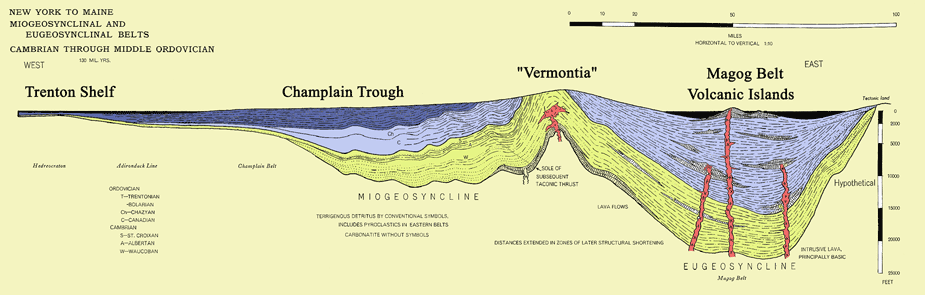
During the development of plate tectonic theories, subsequent workers Bird and Dewey (1970) also looked at the development of the Taconic Orogeny and helped to further refine the tectonic significance of the Taconic disturbance. Having recognized not only the development of marginal subsidence belts (after Kay's miogeosyncline and eugeosyncline), Bird and Dewey further helped to relate the development of these features, among others, to crustal shortening, lithospheric flexure, development of high-angle syndepositional faults in the proximal Trenton Shelf, and low-angle faults in the marginal metamorphic belt of "Vermontia." These authors were the first to document the similarity in pre-orogenic depositional patterns of the pre-Trenton shelf with modern continental shelves. Also they were the first to suggest that the tectonic development of the Taconic Orogeny was analagous with modern tectonic patterns of continental margins that are closely associated with island arcs and trenches. Moreover, these authors realized that in the modern there are trench areas juxtaposed immediately by "continent-ward driven thrust sheets (accretionary prisms)," and when these patterns were compared to the New York to Western New England succession they were remarkably similar. Bird and Dewey understood that the Taconic Orogeny was one event of several that contributed to the growth of the Laurentia Craton by processes of tectonic accretion.
The following diagrams are adapted from those published by Bird and Dewey (1970), and document three phases of tectonic development in eastern Laurentia. In the diagrams, Bird and Dewey emphasize the importance of the tectonic melange, wildflysch, and other faulted and metamorphosed rock materials in the region of Vermontia. Although these authors focus on the specific details of the orogen, that is areas distal from the shelf, their diagrams clearly document the development of syndepositional fault structures in the more proximal areas of the Trenton Shelf and relate them to processes mentioned previously. The middle schematic drawing shows the development of high angle faults that in some cases attenuate upward into the Trenton while others, as shown in the third schematic drawing, show extension of these faults through the entire Trenton Limestone and into the overlying shales of the Utica Group. The presence of these fault structures in the proximal Trenton Shelf region indicate far-field tectonic effects (far from the orogenic center) that were related to onset of foreland basin development, and that these tectonic features were active during the deposition of the Trenton Limestones.

As mentioned, the initiation of development of the Taconic Foreland Basin was coincident with deposition of the Trenton Limestone. However, despite the relatively distant orogenic center (relative to New York State), many localized and more regional tectonic features developed on the Trenton Shelf that were related to events taking place far to the east in the orogen. The following discussion provides some sedimentologic and structural support for localized tectonic development in central New York State including the Trenton Falls region.
Old scars never heal: Ancestral faults & new orogenies
Several types of structural features are often shown on modern structural geology maps of central New York State. The first common yet very subtle structural features are joint sets. Due to tectonic processes including crustal flexure and brittle deformation, the bedrock in central New York State has developed many hundreds to perhaps thousands of joint sets that share similar compass orientations. Based on similarities in compass orientations, these features can be related to one of several phases of orogenic development in eastern North America, including that of the Taconic Orogeny (Jacobi et al., 2000).
A second structural feature shown on these maps are faults. Although significanctly less common than jointing, faults and fault structures provide dramatic evidence for movement of rock bodies relative to one another due to the emplacement of major crustal stresses (either tensional, compressional, or translational). There are many of these structural features that are observed in the Black River to Mohawk Valleys of New York State. In the following map of the southern Adirondack to Mohawk Valley region (modified from Hay and Cisne, 1988), there are two main types of faults diagrammed. The first is referred to as the "Thrust Fault" and although there are some minor examples of thrust faults in areas to the west, the most predominant thrust faults in the region are in eastern New York State. These fault bounded areas are shaded in dark gray and are labeled as the Taconic Front. As discussed earlier, these rock units are part of the "Taconic Melange" and represent materials that were pushed up over the top of the ancestral margin of eastern Laurentia during the Taconic Orogeny. It was the thrust faulting of these same rocks that helped to form the Taconic Foreland Basin which resulted in the deposition of the Trenton Group.


The second kind of fault structure shown on this map is the "Normal Fault." Diagrammed in purple are the linear fault traces of subsurface fault structures. These normal faults show the relative movement of various bedrock block segments relative to one another. As is customary in the diagramming of such features, the hachure mark on the fault trace point to the rock body that moves downward relative to neighboring rock bodies. The map above shows that the Pre-Cambrian (Grenville) to Ordovician rocks in the region between Trenton Falls and Schenectady are broken into several block segments that are bounded by normal faults which trend roughly north by northeast to south by southwest.
The movement of these fault structures, though difficult to see on the surface, show significant vertical displacements of adjacent rock segments when viewed in cross-section. The diagram below is constructed to illustrate the extent of faulting along a cross section that runs along the length of the Black River from Lake Ontario southeastward into the Mohawk Valley and extends to the position of Albany and the Hudson River. As is clearly evident in the diagram, the cross-section shows nearly 30 fault bounded segments between Lake Ontario and the Hudson River. Most of these fault-bounded structures extend downward into Pre-Cambrian Grenville basement rocks and many are clearly related to older structural features.


The arrangement of blocks, that is uplifted or downdropped segments, have been classified in geological nomenclature as either "horst" blocks or "graben" blocks respectively. Given the distribution of Cambrian to lower Ordovician strata and their sedimentologic signatures within some of these block segments, there is good evidence that many of these horst and grabben structures had been present prior to the Late Ordovician (Miller, 1909; Kay, 1953; Fisher, 1954). In fact, many of these features may have been produced during the initial rifting of eastern Laurentia during the formation of the Iapetus Ocean in PreCambrian to Cambrian time (Megathlin, 1938). These fault structures which had remained quiet and unactive for millions of years were reactivated by renewed tectonic stresses during the Taconic Orogeny. Only a few of these faults can be traced southward into the Silurian to Devonian outcrop belt where they show evidence for vertical offsets in these younger rock units. The remainder of the faults show evidence for syn-depositional activation; that is, offset movement along the faults which occurred during the time of deposition of the Trenton Limestones.
Paleontologic and sedimentologic evidence for local syndepositional tectonics
The following diagram provides sedimentologic evidence for syn-depositional fault activation in the region of Poland, New York. The diagram, redrawn from Baird and others (1992), shows a northwest to southeast transect from the region of Trenton Falls to Middleville, NY. From the structural maps above, it is clear that the transect extends across one of the downdropped graben blocks in the Poland to Rathbun Brook region. Baird, Brett and Lehmann used the presence of this fault-bounded feature to explain the abrupt disappearance/thinning of upper Trenton (Rust Formation) deposits to the southeast. The diagram shows the offset of once continuous units including the Poland Member, and the Russia Member (which includes the Wolf Hollow, Brayton Corners and U. Dolgeville as informal subunits). The activation of the fault and subsidence of the graben block coincided with the onset of deposition of the Rust Formation on the northwestern horst block. Sedimentologic and paleontologic evidence suggest that the Rust-equivalent rock units were deposited under anoxic conditions on a steeply dipping seabottom within the graben, which was in stark contrast to depositional conditions that existed just prior to the deposition of the Rust when the region had uniformly flat topographic conditions.

In addition to the work of Baird and others (1992), recent work by Jacobi and Mitchell (2002) has helped to further examine the development and timing of fault bounded blocks in the region immediately southeast of Trenton Falls. Jacobi and Mitchell focused on the Dolgeville and lower Indian Castle formations (upper Trenton equivalents) in the region between West Canada Creek and East Canada Creek. Their paleoflow and paleoslump direction measurements, when considered in stratigraphic order, help to delineate the local pattern of uplift and subsidence associated with movement along major faults in the area including the sub-arcuate Herkimer Fault, the Little Falls Fault Swarm and the easternmost Dolgeville Fault.
The diagram below is modified after that of Jacobi and Mitchell (2002), to include modern geographic landmarks such as major drainage features, and the New York State Thruway (I-90) for reference purposes. The three images show stepwise development of fault features beginning during the deposition of the Upper Dolgeville Formation and extending through the deposition of the Lower Indian Castle Shale. As is illustrated, tectonic activity produced piano key-like movement on the Little Falls fault swarms by as much as 25 m, and show evidence of horst and graben reversals. Perhaps the most important observation to be derived from these diagrams, however, is the step-wise subsidence of eastern graben areas in the vicinity of the Dolgeville fault. This tectonic-induced subsidence represents the most rapid phase of subsidence associated with the migration of the Taconic Foreland Basin foredeep into the central Mohawk Valley region. This downfaulting marks the end of deposition of the Trenton Limestone.
Sherman Falls, photograph by Tom Whiteley